Constructivist Semiotics and the Constructivist Semiotic Sign: An Executable Architecture of Meaning
What makes a sign mean something, and what makes a reading of it right or wrong? I argue that meaning is neither a property of symbols nor a free choice, and that handing interpretation to structure, causation, association, or statistics leaves no one to answer for a reading. I separate automatic attribution, the non-conscious taking of one thing as a sign of another, from interpretation, a conscious act under a goal the interpreter adopts for that act.
On that basis I state Constructivist Semiotics through the Constructivist Semiotic Sign (CSS), whose five constituents must stay distinct: the Identifier, the Concept, the Construct, the Referent, and the Interpreter. I state seven cognitive-semiotic principles and seven computational principles, and I test the architecture in Unified Modeling Language (UML) diagrams and five C# programs that check whether each distinction holds under execution. I then set the CSS against its nearest prior work: Ferdinand de Saussure’s dyad, Charles Sanders Peirce’s triad, Charles William Morris’s interpreter, cognitive semiotics, and Kumiko Tanaka-Ishii’s semiotics of programming.
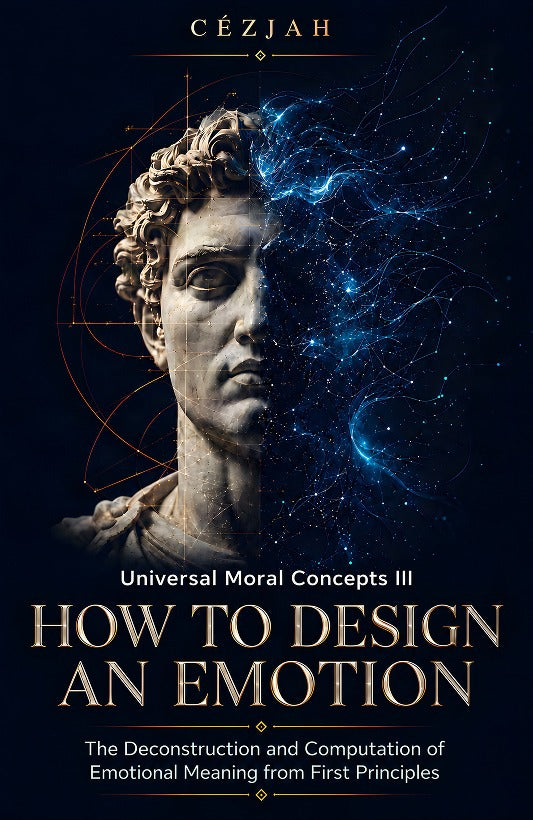
What is new is a goal for the single act as the standard of success, the split between Concept and Construct, and one executable sign that carries into affective life. The full treatment is How to Design an Emotion (2026). Working paper 2 of 8 in the series on the frameworks of How to Design an Emotion: The Deconstruction and Computation of Emotional Meaning from First Principles (Universal Moral Concepts III, New Intellectual LLC, 2026; ISBN 979-8-9898135-9-9 paperback, 979-8-9898135-3-7 Kindle).
The book is the full treatment. Book page: https://newintellectual.com/how-to-design-an-emotion ; related: Part III . Buy on Amazon .